Archive

Posts Tagged ‘Gender Expression’

Allegheny County Ordinance – Call to Action!

June 27th, 2009 View Comments

The text below is from the Delta Foundation. I’d like to write some commentary, but first, I just wanted to get these facts out there for everyone to see.

CALL TO ACTION – ALLEGHENY COUNTY ORDINANCE

As many of you know, the Allegheny County Council will be voting on the Allegheny County Human Relations Ordinance this Wednesday, July 1. Council and the County Executive are expected to give it their final approval.

This process began at Pride 2008 with conversations between Councilperson Amanda Green and several community leaders. Throughout the year, community leaders have worked with Councilperson Green to shape the bill and many community members have voiced support for it.

The ordinance will establish a Human Relations Commission and prohibit most discrimination in employment, housing and public accommodation based on many characteristics including sexual orientation, gender identity and expression. Similar protections have been in place in the City of Pittsburgh for over 20 years. Now most of those protections will be extended to the County borders.

The bill is not perfect. We have major concerns about an amendment (Section 215.31. “Definitions.” Sub-section H. Sub-paragraph 1) made to the bill in the Council’s Government Reform Committee (over the objections of Councilperson Green) on June 18. -This amendment allows religious organizations to discriminate, even if they receive County government funding. This is not allowed in the Pittsburgh ordinance and will make the protections of the Allegheny County Human Relations Ordinance weaker than the Pittsburgh ordinance.

-It allows for discrimination by religious organizations not only on the basis of sexual orientation and gender identity, but also on the basis of race, color, national origin, sex, disability, age, etc.

-The amendment sets up an inane and unconstitutional requirement that religious organizations document their homophobia and transphobia in order to be exempt from the ordinance. So, religious organizations that are BGLT friendly would have to comply with the ordinance while the homophobic organizations can discriminate against anybody for any reason.

-This amendment is potentially a harmful model for statewide non-discrimination legislation.

Some of us who are familiar with the legislation feel the amendment makes the entire bill not worth having for the reasons listed above. On the other hand, some of us feel that the protections the bill offers are substantial and that the bill is at least a step in the right direction. And there is also the strong possibility of striking some of the problematic portions of the legislation in court.
Representatives from our working group are meeting with County Executive Onorato’s staff to try to get rid of as much of this bad language as possible prior to approval of the ordinance. Here is how you can help:

Contact:
County Executive Dan Onorato
Phone: (412) 350-6500 Fax: (412) 350-6512
executive@alleghenycounty.us

Your Council person.
http://www.alleghenycounty.us/council/members.aspx
Ask them to remove the language from the proposed Human Relations Ordinance that allows organizations that receive County funding to discriminate.

Attend the meeting on Wednesday, July 1, 2009 @ 5PM (but come early the room will be packed)
436 Grant Street
4th floor – Gold Room (room may be changed to accommodate large numbers)
Pittsburgh, PA 15219
If you wish, you may speak at the meeting on Wednesday. (You must call ahead and put your name on a list to speak – 412.350.6490)

Thank you for your interest and support!
Coalition for the Allegheny County Human Relations Ordinance

If you appreciate reading my posts, would you like to thank me with a coffee?

Answering Kate’s Question

May 11th, 2009 View Comments

Kate asked:

Do you think HB300 would have more support if the “gender identity” portions were excluded?

Thanks for a good question!

I think that the general public understands “sexual orientation” better than “gender identity and expression” and in that sense, yes, it might seem easier to pass without gender identity and expression, but more generally speaking, no I don’t think that would make that much difference here in Pennsylvania. Unlike how the issue has gone in some other states, here, the primary issues with the bill have nothing to do with transgender issues. It seems to me that there are a few main points that come up over and over in discussions with legislators: 1) Religious Exemption from hiring gay or lesbians; 2) Is this bill really needed? Legislators aren’t aware of how many cases of discrimination happen on a yearly basis; BUT, the big issue is gay marriage! People are afraid that this bill is only put forth to open the door for gay marriage. The reality is that discrimination in housing, employment, and public accommodations is a significant (and in my opinion, more important issue) than gay marriage.

In some other states, where sexual orientation is already covered, transgender protection has been hard for the general public mostly because of the way opponents have stolen the discourse and filled it with misinformation.

I also think that it has to be all or nothing. IF, we really care about equal rights, we can’t accomplish that piece meal, or by sacrificing one group or another. Either we buy into the fact all Pennsylvanians deserve equal protection under the law, or we don’t.

Lastly, “Gender Identity and Expression” is important from the standpoint of protecting gay, lesbian, bisexual and straight people! It isn’t just about transfolk! Consider it this way. A woman goes to work everyday. She has short hair, curt in a somewhat masculine cut. She is never seen in a skirt or dress. She is single, and no details of her personal life are known by her fellow employees. Rumors begin to spread about her. What is the basis of this? Is it her sexual orientation? No!  She is more of a butch woman, but she could be heterosexual, right? When she is passed over for a promotion, or if she experiences any harassment- it is about her gender expression.

Or consider this: A man goes to a job interview. He is quite animated, and talks wit his hands which are a bit flamboyant. He isn’t hired, because the interviewer assumes he is gay. He may be, or he may not, but it is his gender expression, or the perception of it that he is judged by.

OK, one more point, I’d like to make. Gender expression and identity has already been protected in Pittsburgh, and some other locations for quite some time, so in PA, we have a history of these protections. We know that providing these protections state-wide will not have negative impact for the state, but just the opposite. It makes PA more competitive in today’s business world, where companies want to be located in places that value diversity and protect civil rights. Here, opponents can’t use the fear mongering about what horrific things can happen, because, if they were going to happen we would see examples for the many years that transfolk have been protected here in Pittsburgh as well as elsewhere.

Thanks for the question! I wonder what you think? Leave a comment and let me know-

If you appreciate reading my posts, would you like to thank me with a coffee?

Petrarca Meeting: Gay Marriage

April 30th, 2009 View Comments

How Marriage Equality and Non-discrimination Connected

Preface: I began to write this a week ago. Then, at the end of the week, I along with some constituents, met with PA Representative, Joe Petrarca. One of his concerns about PA HB 300 was that it was just a stepping stone for gay marriage. It was clear that while he could possibly vote for a nondiscrimination bill, he is adamantly opposed to same-sex marriage. I intended to write about each of his concerns, and decided that this started-but unpublished post was a good place to write about the issue of PA HB 300 and Marriage Equality.

Over the weekend, I began to think that I needed to re-prioritize my time and focus. Actually, I’ve been thinking that for a while, but have decided I need to take action towards that goal. So, I thought I’d stop writing about Marriage Equality. It is an easy topic to blog about as so much is happening in that arena, but in terms of importance, it is not at the top of my list. By all means, those who are pushing for it, go right ahead and push. But for me, I’d like to re-focus my energy on the battle for other, and what I’d call even more basic civil rights. This would be to write more exclusively on the issues of anti-discrimination legislation and hate-crimes legislation. OK, that is pretty easy to say, but how about operationalizing it? Maybe not as simple. Because for the opposition, these struggles are one in the same, or at least two heads of the same monster. So, on either front, an understanding of the other is important, if not critical to success.

If you read back through my blog, somewhere, way back in the Fall I voiced by basic position on same-sex marriage. I am definitely not against it, but it isn’t the direction I think we ought to be fighting. I think we would get further if the struggle was for same-sex unions that carry 100% of the civil rights that marriage allows heterosexual couples. Now, I get the whole separate but equal is not equal argument, and I actually agree with it. but I think the word Marriage is a black hole of a problem that gets in the way of the real issue which is protecting the rights of families of all types. By focusing on Civil Unions (which is probably a big enough battle as it is) with all the same civil protections, we can avoid some of the whole religious opposition to marriage /destroying the santicty of marriage  battle. There will still be religious opposition, but the arena for the real issue will be civil rights as it should be. But, no one put me in charge, so that is just my opinion- not the direction of the battle itself.

The link below is to a Catholic web site article about same-sex marriage, yet the major evidence they lay out to show how religious liberties are threatened by Marriage Equality, are all cases that have everything to do with discrimination situations. These are becoming, or will become so familiar to any activist, but they are at the foundation of the National Organization for Marriage’s (NOM) recent attack campaign. So, today, I’d like to respond some to this Catholic.net article, and then over time, I’d like to see if I can shed some light on how/why these issues become so entangled,  and what if anything, we can do about it as we work for anti-discrimination legislation in a number of states.

I think this is really important.

I had dinner with my dad last night who is a fairly religious protestant (Methodist) and a conservative republican. While we did not talk about Marriage Equality that explicitly, there is no doubt that he is against it, and sees marriage in the traditional sense of between a man and a woman. But, he told me he also believes that all individuals deserve to be treated fairly, and he can support anti-discrimination legislation to protect against discrimination in housing, employment, and public accommodations. So, understanding how to untangle these two issues will be important to help move anti-discrimination forward.

Although the opposition doesn’t want that to happen. They want these things all entwined because gay marriage is scary to so many. The move towards marriage really fuels the fire and anti-discrimination legislation is one of the targets. Joe Petrarca brought this up. It seemed to me that the possibility that HB 300 would set the stage for same-sex marriage would be enough for him to vote against it.

I have for a while, maintained that nondiscrimination legislation is not a steping stone for Marriage Equality. Not in the sense expressed by those who oppose gay rights. They characterize nondiscrtimination as if it were just a ploy to get the proverbial foot in the door. The reality is however, that these protections are extremely important on their own merit, and are sought out for that alone- the protections they provide. Nothing more and nothing less.

But from a different perspective, nondiscrimination legislation can be seen as foundational for Marriage Equality. What value is the right to be civilly married if you can lose your job solely for being gay or lesbian? hate crimes legislation and nondiscrimination legislation are stepping stones in the sense that they are foundational. Without them existing first for Lesbian and Gay people, Marriage Equality isn’t very useful.

From a different and important perspective however, they are not stepping stones to gay marriage in that both hate crimes and nondiscrimination cover people not affected by same-sex marriage per se. Bisexuals and transgendered people are not as clearly impacted by Marriage Equality, yet are critical recipients of hate crimes and nondiscrimination. We use the phrase “gay rights” loosely, and yet need to remember that is stands for a wide and diverse set of communities and issues that are all related, but not exactly alike. Maybe for the opposition, it is all the same thing. Everything we are talking about in terms of Gay, lesbian, bisexual, transgender, and queer (GLBTQ) is not heterosexuality with Barbie femininity and Ken masculinity.

Over history the rights of some have always been oppressed so that the dominant viewpoint may not be threatened. It is a form of control. For example, well after the Emancipation Proclamation, blacks were still being denied the right to vote out of the belief that if they had that right and executed it- all hell would break out? The belief of some, that these other people were less than equal fueled the desire to maintain control. It was a long time between the declaration of freedom 1862/1863 and the true freedom and right to vote in 1965. Even earlier in the history of slavery, the dominant attempted to control their black slaves by forcing upon them Religion yet, in many parts of the Americas, slaves were kept illiterate. While the tactics used were different, it is not that dissimilar to the ways the modern evangelical and Catholic church wishes to push its doctrine on everyone today. For the slaves, the result was the growth and proliferation of religious practices that continue today on the fringes of Christianity. Santaria is the best example where the catholic indoctrination was fused with ancient African belief systems to form a new religious expression. The religious indoctrination wasn’t really successful. The slaves did not become simply “good christians,” rather the religion evolved and became imbued with meaning and life as the people needed it to be. The desire to force one’s own beliefs on others has never truly been successful anywhere.

At the base of both nondiscrimination and marriage equality is a cornerstone of real equality.  Do GLBTQ people deserve to be treated as equal human beings? If yes, then the next question is how should that equality be actualized. Nondiscrimination and hate crimes legislation look at these questions from the perspective of the individual. Do I as a gay man, and an individual, deserve the right to work, find housing, etc, or is it acceptable to discriminate against me solely on the basis of my sexual orientation? Marriage Equality has nothing to do with that- with individual rights. This is the point where these two subjects have nothing to do with each other , even though both have a cornerstone of equality.

The insistence of the radical right to link nondiscrimination with marriage equality is an example of fear mongering since the term marriage carries such an emotional charge. The slope is a not-so slippery slope. To try to stop same-sex marriage by stopping nondiscrimination laws is like using a hammer to install a screw.

The last way that these two issues are not really connected, is that same-sex marriage legislation is about Civil Marriage as opposed to Religious Marriage. Most if not all of the uproar about it comes from the conservative religious community expressing fear that marriage as they define and know it as a religious covenant will be harmed. The religious institution of marriage is not really on the radar for activist. The goal there is civil protections. Legal nondiscrimination is as far away from the issue of religious marriage as it can be.

Catholic.net – .

If you appreciate reading my posts, would you like to thank me with a coffee?

Gay Marriage And Public Opinion

April 30th, 2009 View Comments

This Forbes.com story provides a number of statistics from polls over time that demonstrate attitudes towards GLBTQ issues. It is a good read.  The title is about Gay Marriage, but the polls deal with many aspects of gay acceptance. for instance, Should Gays have equal rights in terms of job opportunities? 55% said yes, in 1977, and 89% in 2008! Numbers like that demonstrate why protections like PA HB 300 are timely and aligned with public opinion.

Gay Marriage And Public Opinion – Forbes.com.

If you appreciate reading my posts, would you like to thank me with a coffee?

New York Assembly Passes Transgender Rights Bill

April 30th, 2009 View Comments

Reassuring to read that this bill which grants protections in housing, employment, and public accommodations based on gender identity and expression, passed the assembly with only 15 minutes of debate. Unlike our process here in Pennsylvania, where adding sexual orientation and gender identity and expression to the existing non-discrimination laws, PA HB 300,  is turning out to be challenging.

New York Assembly Passes Transgender Rights Bill.

If you appreciate reading my posts, would you like to thank me with a coffee?

Petrarca Meeting: Unintended Consequences

April 28th, 2009 View Comments

Unintended Consequences

Last Thursday, I posted about meeting with PA State Rep Joe Petrarca, and he had four main concerns he expressed about PA HB 300. Today, I’d like to talk about his second concern- that bills sometimes have unintended consequences and should be thought through carefully. This is an important concern and one worth thinking about. It is one where the opponents to this type of leghislation have really had a field day spreading misinformation, and yet it is likely the argument against the legislation that should be taken most seriously. But then, I’d hope any legislation would be subjected to a process by which unintended consequences might be examined.

Rep Petrarca used an example in our meeting of a bill that was designed to get money out to where it was needed. The state gave money to intermediary organizations with the expectation that it would be passed further down, and this didn’t happen. The intermediaries kept the money. Good point. What is in PA HB 300 that would keep unexpected consequences from happening? I think there are two main points to make about this concern.

A simple change to existing PA law

Unlike the representative’s example, this is a very straight-forward bill (no pun intended). It adds language to the existing human relations commission nondiscrimination policies. In his example, there were two needed steps: 1) pass money down, and 2) expect money to be passed down further. Unless the language of the bill was designed to make the second part explicit, a problem could occur. PA HB 300 is quite different. The language is very clear. It adds Sexual Orientation and Gender Identity and Expression. Both of these terms have pretty specific meanings. so there is truly very little ambiguity in the language of the bill. The language chosen is very intentional, and each term speaks to a different form of discrimination.

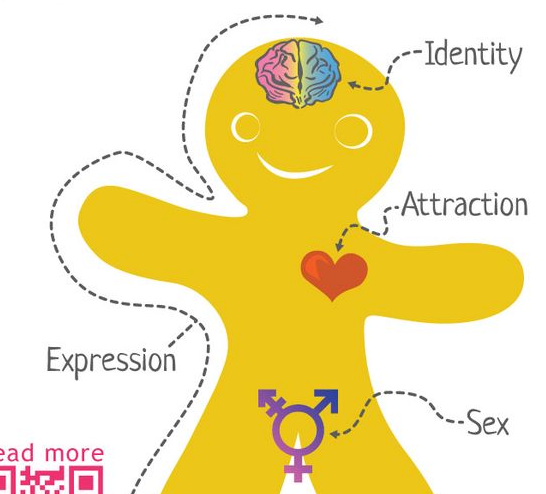
Sexual Orientation has very clear meaning. Individuals are either heterosexual, homosexual, bisexual, or asexual., That’s pretty clear. Gender Identity and Expression are also fairly clear terms, although truly less understood by most people. I think this is because “sexual orientation” has been a topic of conversation and cultural exploration for many years, but Gender Identity and Expression hasn’t had the same exposure. From music (I kissed a Girl) to TV (everything from the Real world to day-time soaps) to movies (MILK!), there is a long history of educating people about sexual orientation. A set of points about Gender Identity and Expression is posted to my blog.

Because this is a change to existing legislation, it is easy to look at the ways the existing protected classes have been interpreted, and where, if any, has the intention of the legislation been abused.

This legislation exists many places

In whole or in part, these protections exist in over 20 states and over 300 municipalities across the country . Of the Fortune 500 companies,  472 including the 27 that name Pennsylvania as home provide these protections already. For example, sexual orientation has been a protected class in Pittsburgh for almost 25 years and Gender Identity and Expression protected for 10 years! If this legislation is the catastrophe-waiting-to-happen that opponents say it is, there would be well documented cases to be found here or elsewhere. But none exist. None. I could find no documented valid case in any of my searching. Opponents to this bill cite 2 examples which I have discussed in an earlier blog post, but when each is investigated, in neither case were the results different from what would be expected. In both cases, a violation of religious expression is cited, but in neither case is that really what happened.

If this legislation was to cause unintended consequences, it would have happened by now somewhere across the 20 states, 472 major companies, or 300 regional or local municipalities where this language is in use.

A good bill for Pennsylvania

While the focus of this post is unintended consequences- as if these would all be negative, it is useful to see how this language can protect many Pennsylvanians who may not even realize what it has to offer them. Consider how Gender Expression protects all Pennsylvanians. There may be a woman, who doesn’t fit the stereotypical example of feminine, but who is passed over for a promotion. She is heterosexual and married, yet her gender expression is judged unfairly. Or a heterosexual man who is assumed to be gay because he dresses well or talks with his hands.

The use of clear language, lack of any known problems from a long history of this type of legislation existing, and the ability to protect all Pennsylvanians, makes this a good piece of legislation for us today.

If you appreciate reading my posts, would you like to thank me with a coffee?

Gender Identity and Expression- What Does it Mean?

April 28th, 2009 View Comments

This information was provided by the Value All Families Coalition

A Quick FAQ on Gender Identity/Expression Protections

In House Bill 300, “gender identity or expression” provides necessary protections for transgender people from discrimination at work, in housing, and in public accommodations.

What is Transgender?

Transgender people are individuals of any age or gender whose appearance or personal characteristics differ from stereotypes about how men and women are “supposed” to be. This generally refers to transsexuals, who live their lives in a gender different than their sex at birth, and also covers people who are androgynous or who cross-dress at home or in social settings outside of work. Transgender also refers to men and women whose appearance or characteristics are perceived to be gender non-conforming, such as a masculine woman or feminine man. Transgender people may be lesbian, gay, bisexual or heterosexual.

Why Are Transgender-inclusive Laws Needed?

Transgender people face severe discrimination based on gender identity and expression. Those living openly have high unemployment rates or are under-employed. Housing and public accommodations are very difficult to obtain or use. For people who are not living openly, disclosure can mean loss of employment or housing. If not actually fired, transgender people who transition while working in their current job often deal with harassment from co-workers.

Isn’t This Already Illegal?

While discrimination against transgender people often occurs due to misperceptions about sexual orientation, transgender people are not protected under sexual orientation. And, courts have held that transgender people are not protected by disability or sex discrimination laws either. Transgender people are only protected in the ten jurisdictions in Pennsylvania that have passed local ordinances banning this discrimination—the first was Harrisburg in 1983. This is about 17% of the state by population.

What Have Other Communities Done?

Other jurisdictions in the United States have successfully passed local and state legislation that protects transgender people from discrimination in employment, education, housing, and public accommodations. By population, 39% of the U.S. is now covered with one of these clearly transgender-inclusive laws, including 13 states and over 100 localities.

What About Business?

Many businesses have voluntarily adopted policies protecting their transgender employees. In fact, as of March 2009, 175 of the Fortune 500 companies have implemented nondiscrimination policies that included gender identity/expression. Judging employees by the quality of their work is considered a best business practice to retain experienced employees and to hire the best qualified applicants. Businesses do not adopt these policies only because it is the right thing to do, they do it for the reason they do most things—it helps the bottom line.

Do These Laws Work?

Because the first law passed in Minneapolis in 1975 and because 39% of the U.S. population lives in a jurisdiction with a gender identity/expression non-discrimination law, there is a lot of information about how these laws work and they work very well. Overwhelmingly, instances of discrimination are resolved informally when an entity is made aware of the law, exactly how these laws are supposed to work. In a small number of cases, a complaint is filed with the local or state enforcement agency, an investigation is done, and a settlement or determination reached. Finally, despite the widespread nature of these laws, only a handful of cases have ever reached the courts. The desired effect of these laws is to deter and reduce discrimination, rather than to punish it after the fact; experience from other states shows that this has been a success.

If you appreciate reading my posts, would you like to thank me with a coffee?

Onorato Voices Support for Fully Inclusive Countty Non-Discrimination Policy

April 27th, 2009 View Comments

Petrarca Meeting Follow-up

April 23rd, 2009 View Comments

I posted this morning that I was headed to Vandergrift to meet with state rep Petrarca and some of his constituents, and wanted to write a follow up about the meeting. Meetings of this type are called lobbying your representative. Today was a bit of “walking the walk” for me. I’ve been posting for a few months now about how important these one-on-one meetings are to issues like PA HB300. Not only are they effective, they touch upon the very basis of our democratic process. So, today, I had a chance to put into practice the Instruction Booklet I wrote and that can be downloaded from my blog. PA HB 300 adds to the existing PA non-discrimination laws by adding sexual orientation and gender identity and expression as protected classes.

Joe Petrarca is a really likable guy and it was easy to talk with him He listened to what our gathered group had to say, and ask good questions as a means to better understand how this bill would affect the lives of everyday people in the state of Pennsylvania. so let me follow the instruction booklet and see how all the steps worked to make a successful meeting.

Brian, who lives in Vandergrift, scheduled the meeting. Which turned out to be pretty simple. If there is a hard part of this, it is that representatives are generally in their districts available to meet on Thursdays and Fridays. I was already off today for vacation but the others had to take the time from work for the meeting.

We prepared for the meeting in a few ways. We each knew what we wanted to say, and went over a plan for how we could allow the meeting to work beforehand. Brian had met with him previously about HB1400, a predecessor to HB 300, so we had some idea as to what his concerns were at that time.

we arrived pretty much right on time for the meeting with a box of donuts for the office staff. In my instructions I write:

Remember that everyone in the room wants the same thing: what is best for the State and its constituents. Your role is to help the elected official and his or her staff understand how the issue or legislation at hand will accomplish that shared goal.

That is really what happened. Petrarca’s interest in that outcome as well as that of all of us present was very clear.

The last 2 steps of the process is to follow up with a thank you note and continue to build the relationship which we all are going to do.

There! That wasn’t so hard!

If you have read my posts and feel hesitant to take that next step and meet with your rep, please take my word for it. It really is that easy, and it is very valuable!

I wouldn’t be surprised if today was the first time, Joe Petrarca met a transperson. That alone was powerful: for him to hear a person talk about how this bill will impact her life. All of us know that on some level, there is little special about us. We really are just like everyone else. But that is exactly part of what we need to share. So take the next step- meet with your state rep and ask them to support PA HB 300.

Joe expressed a few concerns that I think are worth talking about. I’ll most likely break them up over a few posts but the first one I want to address is this. Joe expressed that many in Harrisburg aren’t sure there is really a discrimination problem to address. Do people really lose their jobs or fail to get hired? Do people have trouble getting housing? What does discrimination in public accommodations look like in the state?

This is a double-edged sword. On the one hand, GLBTQ folks may not want to come out and identify themselves out of fear of discrimination, and on the other hand, if they don’t come out  and give voice to their experience, no one knows what discrimination has occurred. A lawyer I know shared with me that even in situations where sexual orientation was the reason for the action, a person’s lawyer may hide that and focus on sex discrimination since sex is already a protected class. So the case won’t be understood as sexual orientation discrimination even if that was what it was.

To help legislators like Joe understand this issue, we need to be able to show him examples where discrimination has occurred, and also help him understand the degree to which GLBTQ people may live in the closet  so as to protect themselves as much as possible.

Joe Petrarca said himself, “no one deserves to be discriminated against.” If we can continue to speak to the concerns about this bill, we will continue to mopve thios bil towards successful passage.

If you appreciate reading my posts, would you like to thank me with a coffee?

Babette Joseph’s Quote Clarified

April 23rd, 2009 View Comments

I posted earlier about a conservative blog called A Right Turn. The link to at the bottom of this post. The post is interesting in that the writer claims that no one should be discriminated against only for being gay or transgender, but then goes on to claim the bill does many things it does not do. PA HB 300 provides protection based on sexual orientation and gender identity and expression in the areas of housing, employment, and public accommodations. Here is what was said in terms of Babette Joseph:

State Government Committee Chairwoman Babette Josephs, D, 182nd, Philadelphia claims that 80% of Pennsylvanians could be kicked out of their apartments, treated badly in public accommodations,or lose their jobs if this bill isn’t passed. She has taken her cue’s from President Obama well, again another democrat trying to play alarmist to get their agenda pasts. Just as Obama has over and over created a crisis and fear to hurry through spending legislation Ms. Josephs is attempting to create the fear that most of us are at risk. The fact is the gay and trans gendered population of Pennsylvania is FAR lower that 80% of our population.

I contacted her office for a clarification and received this in reply:

What I actually said was that 80% of Pennsylvanians live or work in communities that do not offer the protections from discrimination that House Bill 300 provides. To put it another way, only 20% of Pennsylvanians live in communities that offer these protections.

This refers to the 13 municipalities in Pennsylvania that have already enacted civil rights protections on their own accord. Allentown, Easton, Erie County, Harrisburg, Lancaster, Lansdowne, New Hope, Philadelphia, Pittsburgh, Scranton, Swarthmore, West Chester and York each have municipal ordinances similar to H.B. 300. State College also has an ordinance that covers only sexual orientation in housing and employment. But the fact remains that an individual can live in Harrisburg and be protected from discrimination and lose these protections by crossing the bridge to his place of work in Camp Hill. House Bill 300 addresses this problem by giving state-wide protections to people in Pennsylvania from another highly documented form of discrimination. It is neither justified nor defensible for a person’s geographical location to effect the basic right to live and work without discrimination in our Commonwealth.

Representative Babette Josephs

http://arighturn.com/right.php/2009/03/17/pa-house-bill-300#c10

If you appreciate reading my posts, would you like to thank me with a coffee?