Archive

Posts Tagged ‘lesbian’

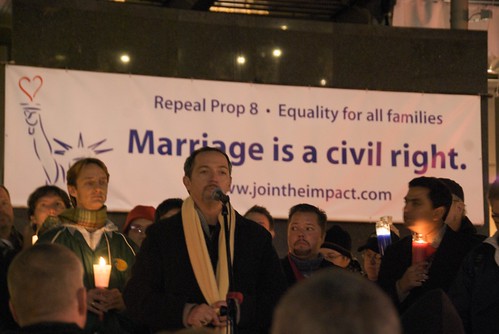
Strategies Towards Marriage Equality

November 14th, 2009 View Comments

With a record of 0-31 when it comes to public votes on same-sex marriage, you would think there would be more dialogue within the LGBT community about why we can’t seem to get anywhere with this issue. Rightly or wrongly, marriage equality opponents use these losses- the losses they keep generating for us- as proof that the majority of people do not approve of marriage equality, and therefor, there should be no marriage equality. This is a difficult argument to battle, because the numbers are what they are. Votes for and votes against, the numbers say it all, right?

I detailed a few of the things I felt the broader GLBTQ community would need to look at when I talked about the election 2009 results last week, but if you don’t go back and read that post, here they are in a nutshell:

  • Our game plan. If we know what the game plan is for the opposition, why are we not defending against it, and why are we not prepared for their antics since they just keep doing the same thing over and over.
  • Our financial support. Are we as a community supporting these battles adequately?
  • Polling and the data we use to base our decisions. What is it that we are missing when it comes to polling. Why are these predictions and numbers so far off of the real vote?

In the days since the election, there has been very little discussion of any of these things. Maybe that makes sense. Behind close doors, those who are leading the battles for equal rights are strategizing and trying to figure out their next steps, but at some point, that dialogue must leave the closed door session and begin to educate the grass roots network.

One topic that has been making a big splash across the Twitterverse and Blogosphere, is the notion that it is just wrong for people to be voting on the rights of others. As ideas go, this one seems like a no-brainer. Of course, it is wrong to allow others to vote on our rights. This was expressed most recently on a Twitter post by my friend and fellow blogger Matt Algren:

@MattAlgren: The new #marryME short doc convinces me even more that participating in unconstitutional votes on civil rights is downright wrong.

Even if this one seems like a no-brainer, I think it is critical to move cautiously in this direction. We need to remember who we are doing battle with, and what are their general strategies for success. Ourt anti-gay opponents never deal with logic, fact or reason, but focus on fear mongering with lies, misinformation, and a warped sense of the role of religion in secular life. So, if we push the “it is wrong to vote..” strategy, what are the possible ramifications down the line? How might this argument be countered? What could be the unexpected consequences from taking a position that essentially says that public votes are wrong? And what do we mean by “[our] civil rights?”

I also wrote last week about the Church’s line in the sand- where do they draw the line, and what does that matter? While that post dealt specifically with the Mormon Church, last week’s efforts by the Catholic Diocese in Washington DC display the same position. The battle, at least for some, is all about protecting the institution of marriage. In other words, the battle is about shifting cultural norms and attitudes through changing cultural constructs such as marriage and the family. Talking about cultural constructs, may seem abstract and meaningless for people who are on the short end of being treated differently than the rest. Discrimination, being denied equality feels quite real, and not like a construct at all. but no matter how it feels, the institution of marriage, and the construct of the family are very much cultural constructs that didn’t get created overnight.

Another arena where we see this type of thing being played out, is the current Health Care Reform debate. In that situation, we have the philosophical notion of small government pitted against the real needs of real people who are hurting and even dying without health care. The conservatives don’t talk about it as “small government.” Their language is “don’t let the government take over health care.” Do you see the parallel here with the anti-gay position that allowing gay marriage will destroy the sanctity of marriage? Both small government and the institution of marriage are constructs, and are threatened by change.

I propose one reason we are 0-31, is that we continue to fail to grapple with the real battle which is fear of cultural change. We continue to seek a political fix for a cultural problem, and not only do we want a political fix, but we want it ,right now! The opposition plays into the general public’s fears, and we keep talking about what is the right thing to do, and we keep coming up short. We do too little to speak directly to those fears and try and counter them with reality, and when we do counter them, we do it too late. We know what fears the opposition will use, and yet we seem caught off guard every time they come up.

I want to hit hard on this notion of cultural change vs political fix today, because of another item from the news last week. The Stupack amendment was added to the House health care reform bill, which would essentially set a woman’s right to choose back several decades. Stupack, a democrat no less, introduced a measure that takes rights away from women, and if passed would score a major victory for the culturally conservative opponents to choice. What does this have to do with gay rights?

We must see the parallels in the way cultural change and the cultural notions of morality are very different beasts from the political reality of what laws say. Some would claim that a right to choice has been a done deal since Roe v Wade, but we all know that isn’t the case, and we live in fear that if the Supreme Court received enough extreme right wing judges, this law could be over-turned.  If we want to see all families- same-sex as well as opposite sex being treated equally and fairly, we must come to terms with the cultural constructs of marriage and the family. Today, the Church feels they own these constructs, and the Church is a construct as well. So we will continue to fail when we battle real religious people rather than the construct of power that we call the Church. We will continue to fail when we dismiss the fears of the majority, rather than counter them with truth. Let me clarify what I just said. By real religious people- I do not mean those who are extremely religious. I mean those flesh and blood individuals who hold their faith as a critical part of their mindset and world view. We battle them, and we lose. If we begin to sort out why the construct of Church holds the power, we can make progress, while allowing people to keep their personal faith.

If you appreciate reading my posts, would you like to thank me with a coffee?

Lesbian High School Student Banned from Yearbook

October 15th, 2009 View Comments

This is an extremely interesting and frustrating story, that appears to be about gender as well as sexual identity.

A high school senior in Wesson, Mississippi, has been banned from her high school yearbook because she wore a tuxedo in her photo. Ceara Sturgis was told by school officials that her attire in her yearbook photo was inappropriate for her gender

….the local board of education released a simple statement saying that the matter does, in fact, go deeper than the tuxedo. Sturgis is a lesbian and has been out since the ninth grade. While no officials will say so directly, it seems that the real reason behind the ban is the girl’s sexual orientation.

No matter if the issue is the sexual orientation or a lack of gender conformity, it is difficult to see the principal’s position in this one. The principal’s office is directing questions to the school board, and the school board is saying that the decision with the year book rests completely with the principal.

Lesbian High School Student Banned from Yearbook | CarnalNation.

If you appreciate reading my posts, would you like to thank me with a coffee?

Sexism and Homophobia: DADT?

October 9th, 2009 View Comments

Of those discharged under the policy, 36 percent were women, although women make up only 14 percent of troops in the Army, the data showed.

Yesterday I posted about Mary Cheney, her new baby and some of the connections between class and the resistance to LGBT rights of any kind, but especially same-sex marriage. I received several very kind and meaningful compliments for the post, and thanks to those from whom I received the calls and comments. But re-reading the post, I’m not sure I did much other than lay out the questions. Don’t think I answered too many of them or illustrated the points all that well.

Today’s post may end up being similar, and if you have thoughts about the issues raised, please please chime in and share them with a comment. The linked CNN story is quite short and I’ll look for more to better explain this story, but basically it says that more women are discharged proportionately more than men using DADT. This was a big surprise for me, because most (all??) of the high profile cases I’m aware of, are men. Guys like Dan Choi for example. Racking my brain (although that rarely helps) I can’t remember a single high profile/publicized case of a woman being discharged for DADT. What’s up with that? There are probably a few good thesis projects in here, so if you use one of them, please give me an acknowledgement in your published thesis or dissertation.

One thing before I go on, the CNN title is a little misleading: “More women than men dismissed from military for being gay.” It isn’t true to say that of 100 discharges more of them are women. Women are 36% of the discharges. but given that women make up only 16% of the armed forces, this rate of 36% seems very high. It suggests a lesbian is twice as likely to get kicked out as her gay counterpart. Or is that four times as likely… I need a stats class!

Here are some of the questions raised for me:

  • Are more women discharged because a disproportionately larger number of lesbians join the armed forces than men? For example, if 100 gays and lesbians join the armed forces, are 70 of them women? Probably no easy way to answer this given the nature of don’t ask, don’t tell. My reasoning here, is that if queer men and women are discharged at an equal rate, then the number of women discharged would be closer to 16% unless more women who enter are lesbians than the number of men who enter are gay. I would doubt this. My guess is that more gay men enter the armed forces than lesbians, or that the rate is closer to equal.
  • Are gay men accepted by their colleagues more commonly than lesbians? In other words, while many good and qualified people are kicked out, it might be the case that a number of troops accept their gay and lesbian members, but especially their gay members. Perhaps a gay man is more accepted than his female counterpart and is less likely to be called into question.
  • Do gay men, “hide” better in the military than gay women? Is the reason for the disproportionately higher rate among women because their gay counterparts are able to blend in easier than the women are, so that the women are found easier? This may be connected to the earlier question. Is it that they blend in and hide easier or just that others choose not to see them as readily?
  • Are the methods for outing gay men and lesbian women the same or different in the military? In otherwords, how is it that most lesbians are discovered , and is that the same or different than for gay men?

I tend to think that there is a role for basic sexism in the equation. Women are a minority within the armed forces and still seen by some, as not belonging there. The levels of testosterone are high among the armed forces, and I would anticipate that many women struggle to be treated as equal, even without the marker of being a lesbian added to it. Straight men love the notion of lesbians as play toys for real men, but the notion that a woman as equal to them, that one is a stretch for many men. Gender roles and forced notions of what being Male and what being Female mean is still a prevailing dynamic in our society as a whole, and would most definitely be at play within a microcosmic and performance heightened arena of the military.

Add your thoughts- add a comment- let me know what you think!

via More women than men dismissed from military for being gay – CNN.com.

If you appreciate reading my posts, would you like to thank me with a coffee?

Categories: general Tags: , , , , ,

Two Mommies To Have Two Babies

October 8th, 2009 View Comments

@oneloveblog posted about this on Twitter today, and I wanted to add a few thoughts. Mary Cheney and her “long-time partner” are having another baby. While Mary hasn’t been the rabid supporter of crazy stuff like her sister, she has none the less remained very loyal to her father and the conservative movement, and after this birth is planning to start a consulting business with her sister, Liz. How scary is that?

First, I wish her all the best as her family grows. Real families are lesbian and gay families every bit as much as they are straight families, and I applaud her for continuing to make that visible. I think too, it really demands that those of us who are fighting for full equal rights  stop and consider what all of this means.  How is it that within the conservative movement that seems to rely on either Family Values or defending our country, that this image of a gay family exists and has so little power to change minds or the actions of the conservative movement? In other words, why do we let the conservative right,  ”own” family values as if it were a conservative idea, and progressives get framed as anti-family?

For me, this isn’t just about gay marriage, although the legal recognition of same-sex marriage is one major step in protecting gay and lesbian families. It is rather, about visibility, and it is about money or status. If the Cheneys didn’t hold the solid place so close to the core of the Republican Party, would a lesbian mom-to-be ever be such a prominent figure? Or would she have been pushed aside long ago? Why do the rights and privileges of marriage seem unimportant to Mary Cheney and her partner? What role does money and power play to provide them the safety net or other things that help support their family?

While the Republican Party is scrambling to redefine itself, and the far right faction seems to have taken over, one of the other main tenets of conservatism is small government and fiscal responsibility which equates to cutting taxes on the rich, and cutting programs for the poor and middle class. If we are to make headway from a legislative perspective on gay marriage and legal support for GLBTQ families, we need to reframe the “Family Values” discourse, so that it is less about upholding the Bible, and it becomes about actually doing things that help real families- all families thrive. We also need to recognize the role played by the “fiscal responsibility” arm of conservatism. We need to make visible the class elements of it, and identify how this is used along with the far right anti-gay parts of the conservative movement. In other words, it isn’t just the Bible-thumping anti-gay message that keeps conservatives from denying full equality to all families. It is the energy and emotionalism from this anti-gay hatred, supported by the basic class-based status quo.

Until we do, some gay and lesbian families, those in a place of power and wealth will continue to do fine, while the vast majority have no rights.

Kate Klonick – Full Court Press – Mary Cheney pregnant with second child – True/Slant.

If you appreciate reading my posts, would you like to thank me with a coffee?

Death by Diversity?

September 15th, 2009 View Comments

The linked article is not the kind of thing I generally post or write about, but today, struck me as very important. During a phone call this weekend with an activist I have the highest regard for, we were talking about the upcoming Equality March on Washington, and the issue of organizing at the state level for legislative change vs a different approach to prioritize for national legislative change instead. I want to write more about my decision to attend the Equality March, and so will touch more on that aspect of it then, but I want to say a bit about why I am opposed to an isolated insistance on national legislative change for GLBTQ issues.

If we learned nothing from the Black Civil Rights movement, I hope we have learned that simply changing a few laws does not make prejudice go away. The path to full equality is made up of smaller steps, with each step gaining some ground. And even with full equality on the books as laws governing our society, the effects of years of inequality still abound. Or look to the fight for reproductive freedom and the battle over abortion. This may be a fight closer in many ways to the gay civil rights movement, or the opposition uses the same religious weaponry to battle a woman’s right to choice  as they do against homosexuality. When an abortion doctor, who operated completely within the law,  can be gunned down, in his church- one has to ask, if achieving some form of legislative win will solve much in terms of how homophobia leads to violence, abuse, and mistreatment of gay, lesbian, bisexual and transgendered people. We need laws, and we need cultural change. These two must go hand in hand and each support the other.

But what about underneath the easy-to-talk-about political layer? It is easy to write about how GLBTQ’s deserve equal rights, and having full equality will make a difference in many ways for many people, especially when viewed from a general or almost theoretical perspective. But what are the issues affecting real, gay, lesbian, bisexual, and transgender people, day to day, in their real lives? What does it mean to talk about a GLBTQ community or culture, especially in relation to the greater society as a whole?

Much of my focus, if you have been reading my blog, has been on PA HB 300, which would add sexual orientation and gender identity and expression to the states nondiscrimination legislation. And I’m 100% committed to that as an important legislative agenda here in Pennsylvania. But recently, two other issues have been rising to the top of my priority list: Hate Crimes legislation and Anti-bullying legislation, which really seem connected in my line of reasoning. When we allow the use of homophobic slurs and bullying in our schools, we are setting the stage for people to act out violently against anyone seen as different from the norm, and especially gay, lesbian, bisexual and transgenders. A hate crime is bullying gone way to far. That is over simplified, but I hope you get my point.

As usual, I have strayed away from the linked article trying to set the stage for it. If we are focused only on legislative advances we fail to see and address the ongoing effects within our communities, that are a result to some extent of the level of homophobia and anti-gay sentiment that we live in 24/7/365. Changing laws alone won’t either fix the problems this has caused nor alter the elements of our culture that are the result of it. So, at the same time as we work for full equality, we must also look at how it has impacted us. The linked article is a very good read toward that end.

Reeuq.com – Gay Social Media Done Right!.

If you appreciate reading my posts, would you like to thank me with a coffee?

Hip-Hop and Homosexuality

August 6th, 2009 View Comments

@Cocoa_Goddess72 DM’ed me on Twitter with a link to this Slate article which is a very interesting read. Personally, I am pretty stupid when it comes to hip-hop and rap, and in general really struggle with it, except for the dancing! I could sit and watch dancers hip-hop forever in total amazement. But the music, the lyrics? I struggle. Even in the struggle, I’ve had a certain appreciation for the way rap is a “new” use of poetry in a radical role, subversive to the status quo and attacking back against the White Upper Class that oppresses black youth. Or at least I think it could be that, except that from the outside, the misongynist and homophobic lyrics seem to have become their own status quo. but here comes a Slate article that can help me better grasp this idea of “no homo.” I encourage you to chech it out and read it all, even if you aren’t too sure about it. I think there is a lot going on and some really awesome ideas in there.

But I want to leave you with this video clip of lesbian hip-hop performers God-des and She:

YouTube Preview Image

If you appreciate reading my posts, would you like to thank me with a coffee?

Why Same-Sex MMMM Matters

July 28th, 2009 View Comments

Refused Visitation to Dying Spouse : Why Same-Sex Marriage Matters

So, you are most likely wondering what Same-sex MMMM (SSMMMM) is, or you have decided it must be a typo. But no, I meant exactly what I typed. Since a term that belongs with an “M” seems to stop all dialogue because people get afraid that we (gays and lesbians) are trying to redefine it, I thought I would get around that by using the term MMMM. I want to talk about a linked blog that I think illustrates one of the many reasons why SSMMMM is so critical. There are well over 1000 rights and privileges that straight couples enjoy. But is “enjoy” the right term at all? So, I’m emailing a conservative guy I exchanged comments with last week, and asked him to read this post and hopefully add his ideas about the story presented here. I propose that we need equality for gay and lesbian couples to protect families from this type of pain and suffering. That’s why I’m not sure “enjoy” is the right word. I doubt anyone enjoys the right to be with a loved one in extreme sickness or as they are dying.

My question is, is it worth it? Is keeping same -sex couples legally apart worth it when it can cause this type of pain? Or is there a middle ground where equal rights and religious liberty can both exist? I have my ideas on what that middle ground might look like, but I wonder what you think.

Please read the linked story and then add your comments here on the blog.

Refused Visitation to Dying Spouse : Queer Visions | Gay Rights Media.

If you appreciate reading my posts, would you like to thank me with a coffee?

Gays OK for Cable, But Not TV?

July 28th, 2009 View Comments

HBO leads on TV in showing homosexual characters

HBO scored highest among 15 networks for its representation of homosexual characters last season, according to a report released Monday.  That totaled 42 percent of the network’s programming hours, in series such as True Blood, Entourage and The No. 1 Ladies’ Detective Agency. By contrast, on NBC and CBS only 8 percent and 5 percent, respectively, of prime-time hours included them, the report said.

I think there are are a few ways to think about this. On one level, it is an easy one. Cable seems to be willing to portray GLBTQ characters, even if most of them are white and fairly mainstream. That means GL and few BTQ characters.  It is easy to knock that as not enough, but the harder question is how much is enough, and what types of characters do we need to see who are currently missing from portrayal?

A different way to think about this is to look at the type of characters we are seeing.  In this case, if Logo is included, we see a fairly wide variety of characters in differing scenarios and situations. But the number of hours of programming with non-straight characters is still too low. GLBTQ people are part of 100 % of our society and culture, so why are these characters not a part of 100% of the hours of programming?

I think a better question to explore is what type of characters do GLBTQ people feel we need to see more on programming. Or, flipped 180 degrees, is specifying the types of characters we want to see a process in itself of censorship? The movie debut of Bruno this summer shows that queers have some strong ideas about how they are presented. I’ve been amazed at some of the way various queers have come down on the issue of Bruno. Both Peter Paige (Queer as Folk) and Nick Verreos (Project Runway) express concern about Bruno, going so far as calling it dangerous, yet they themselves have portrayed a very limited spectrum of gay men. It is harder to knock Verreos, given he was simply being himself on the reality show. One has to ask though how many gay male designers do we need to see when they fit a fairly narrow strereotype ? At the other end of te spectrum, was Lance Bass on Dancing with the Stars. It is no secret that Lance is gay, and yet his sexual orientation had no real expression at all on the show. Granted, Bruno is easy to trash as being too far “out there and stereotypical,” but the point remains- who should decide what type of characters and characterizations do we need to see on TV to adequately present GLBTQ persons in our culture? Peter Paige says:

“When you see a clip of Brüno in a room full of gay men, everyone laughs, and it’s fine,” Queer as Folk actor Peter Paige told Third Rail Media. “But when you see a clip of Brüno in a room full of straight men, they’re all laughing, and it’s a different thing, and you start to go, ‘Hmmmm, I don’t know how I feel about this.’”

Yet, at the time of Queer as Folk, Paige’s character was the gayest thing ever on cable, and many gays thought he was too stereotypical.

The linked story is in a Christian publication, and links to a survey which I present below. Their point is self evident. I couldn’t genuinely choose any of their choices. But for those who are not afraid of the gay in cable or TV, the more important questions are not the choices presented below, but rather, what representations of gays, lesbians, bisexuals and transgenders are missing?

What is the impact of positive portrayals of homosexuality on network and cable TV? (related article)

  • Desensitization to sin
  • Increase in homosexual experimentation
  • Marginalization of traditional values
  • Increase in Christian outreach to homosexuals

HBO leads on TV in showing homosexual characters (OneNewsNow.com) .

For the record, I loved Paige in QAF, as well as all the other characters. I thought QAF was a ground breaking show that never got the attention it deserved for doing what it did, present fairly real portrayals of a variety of friends who were unashamedly gay.

  • If you appreciate reading my posts, would you like to thank me with a coffee?

    Categories: general Tags: , , , , , ,

    Kiss Me!

    July 27th, 2009 View Comments
    Categories: general Tags: , ,

    The Re-Christianizing of America

    July 20th, 2009 View Comments

    The video linked is also embedded in the Pam’s House Blend story linked below, and she found it at Box Turtle Bulletin from last week. I wanted to post it, but also wanted to consider the context within which to post it, and thanks to Pat Robertson, I found that context.

    The idea of “Christian” carries a negative connotation for many folks, and verbal Christian-bashing is as common among some gay people as verbal gay-bashing is among dome Christians. It isn’t much of a stretch to the conclusion that there is a battle between gay people and Christianity.  A few months ago, I called a pastor friend about use of her church for a training session, and she, at first, said no, because something I had said (maybe here on my blog, or on my podcast, Queer Look at the Bible, or maybe just on Twitter or Facebook) ticked her off, and she called it anti-God. Who is fighting with whom- that’s an interesting question.

    I don’t believe the battle is really between gays and Christianity, even though some on the Christian right want to portray it that way. I think the real battle is actually within Christianity itself, and standard operating procedure for some, is to use the GLBTQ community as both a weapon, and fuel for the fire of their fight. And this is a critically important distinction to make because “gay as opponent” and “gay as weapon” defines both our role, and their perspective of us differently, and ultimately can influence our response.

    The people most brutally damaged in this, are those young queers just coming out, especially those from a very conservative or Christian family. For these young women and men, coming to grips with one part of their “self” while being taught that that “self” is an abomination can lead to much internalized shame. The other group most badly damaged by this, are those gay, lesbian, bisexual, transgender, and queer folk for whom, religion and their faith play a central part in their lives. These folks often feel betwixt ands between two worlds, alienated on both sides. The gay side sees them as freaky for placing their personal faith experience as central in their lives, and the religious side views them with disgust.

    Even where welcome, it can be tenuous. I remember a number of years ago, attending a Methodist church which had a reputation for being welcoming to gays. Not long after starting to attend, a pastor (who is actually extremely supportive of the GLBTQ community) confided in me that when she had looked out that sunday morning, and saw me with a black leather biker jacket, she was a bit frightened. But these personal ramblings are taking me off topic.

    The real battle is within Christianity overall, as parts of that faith tradition evolve and others seek to keep things at the status quo. So, watch the video, and then watch the second video of Pat Robertson, who expresses the desire for the Episcopalian Church as a whole to just disappear.

    Here is where our (GLBTQ) perception of where we fit in the battle has importance: If we see ourselves as the battled enemy, it is easy to operate from a place of victimhood, where too much emotional energy is lost as individuals work to counter the inner battles for self worth. We also, end up dismantling relationships and community by battling each other. If, on the other hand, we recognize that homosexuality is being used as a wedge issue- as a weapon to try and stop change, we do not have to feel quite so victimized. We hold actually, far more power than we might imagine from that vantage point.

    Faith is, at the core, a personal and individual inner experience. Faith is practiced in community for a number of reasons, but the battle we are talking about isn’t really about Faith at all. It is about control, and rigid rules. I would go so far as to say, it is fueled by the refusal to seek and appreciate faith. As long as denominations like The Episcopalian Church continues to seek new understandings of the fullness of God’s covenant with all, those of little faith who need to have rigid rules to feel comfortable will continue to use gays as a weapon, and try and make it be about us- when it isn’t really. It is about their unwillingness explore the bigness of God.

    Pam’s House Blend:: Open thread – fundie quote of the day: Scott Lively .

    If you appreciate reading my posts, would you like to thank me with a coffee?